Model check
Is my water heater big enough?
Describe your busiest hour, then enter the heater’s First Hour Rating (tank) or rated flow and rise (tankless) from its spec sheet. The check tells you whether it meets the requirement and by how much.
Minimum First Hour Rating 36 gallons per hour
Minimum First Hour Rating
36gal/hr
Choose a tank whose First Hour Rating is at least 36 gallons. It is printed on the yellow EnergyGuide label and the spec sheet. Tank capacity alone is not the number to compare.
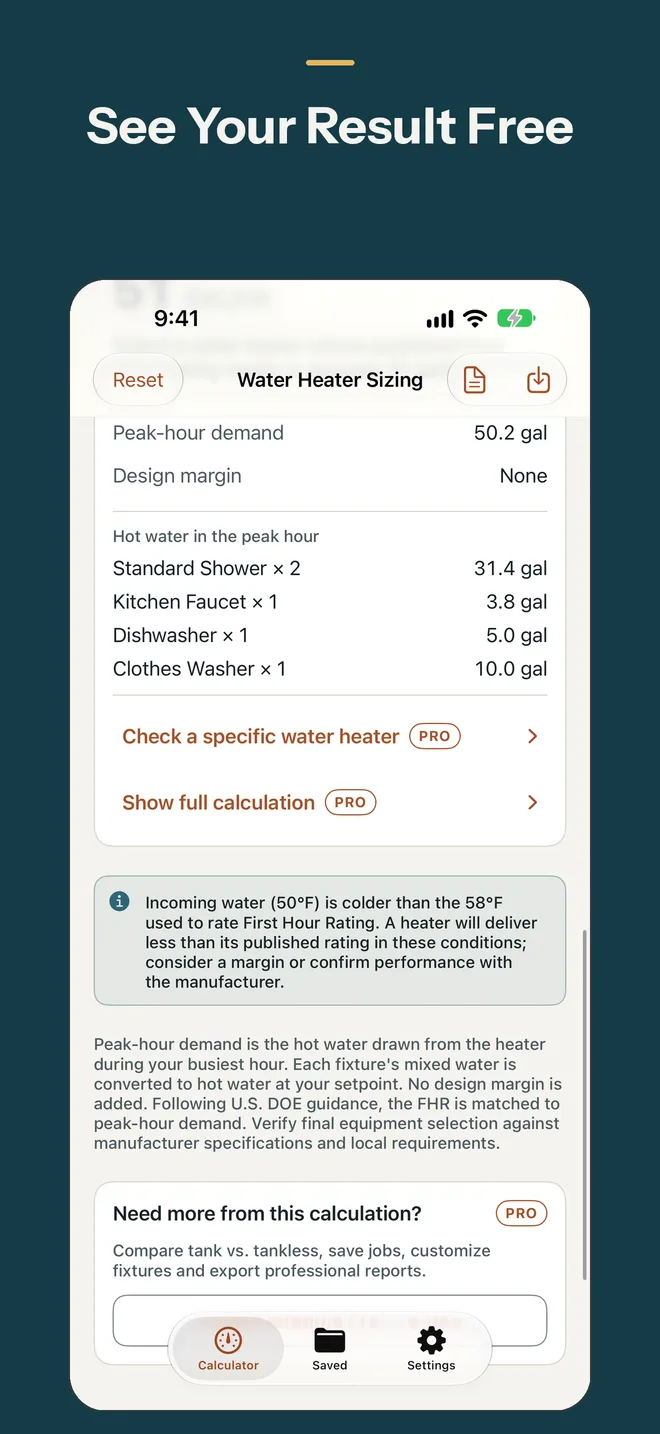
- Standard Shower × 2
- 31.4 gal
- Kitchen Faucet × 1
- 3.8 gal
- Peak-hour hot water
- 35.2 gal
- NoteIncoming water (50°F) is colder than the 58°F used to rate First Hour Rating. A heater will deliver less than its published rating in these conditions; consider a margin or confirm performance with the manufacturer.
Check a specific water heaterFrom its spec sheet
Show the math7 steps
Hot fraction — Standard Shower
(Use temp − Inlet) ÷ (Setpoint − Inlet)
(105 − 50) ÷ (120 − 50) equals 0.786
Peak-hour hot water — Standard Shower
Uses × Flow × Duration × Hot fraction
2 × 2.5 gpm × 8 min × 0.786 equals 31.4 gal
Hot fraction — Kitchen Faucet
(Use temp − Inlet) ÷ (Setpoint − Inlet)
(110 − 50) ÷ (120 − 50) equals 0.857
Peak-hour hot water — Kitchen Faucet
Uses × Flow × Duration × Hot fraction
1 × 2.2 gpm × 2 min × 0.857 equals 3.8 gal
Peak-hour demand
Sum of peak-hour hot water
31.4 gal + 3.8 gal equals 35.2 gal
Design margin
Peak-hour demand × Margin
35.2 gal × 0% equals 0.0 gal
Minimum First Hour Rating
Peak-hour demand + Design margin, rounded up to a whole gallon
35.2 gal + 0.0 gal equals 36 gal/hr
Same formulas, defaults and wording as the iPhone app. Read the methodology and sources.
How the check works
Tank water heaters
A tank meets the requirement when its published First Hour Rating is at least the required FHR. Tank capacity is shown for reference only, because FHR already includes both stored water and recovery.
Example: a family whose busiest hour has three showers, two sink uses, the kitchen tap and a dishwasher load needs a minimum FHR of 59 gallons. A tank rated at 67 gallons passes with room to spare; one rated at 53 does not, whatever its tank size.
Tankless water heaters
A tankless unit meets the requirement when its flow at your temperature rise is at least the required flow and, if you enter it, its maximum input covers the heat load at its efficiency. Flow published at a smaller rise than yours is scaled down.
Example: with 45°F winter water and a 120°F outlet, two showers and the kitchen tap need 5.91 gpm at a 75°F rise. A unit rated 5.0 gpm at the standard 67°F rise delivers an estimated 4.47 gpm at 75°F, so it falls short.
Where to find the numbers
- Rating plate: the label on the heater gives the model number, input (BTU/hr or element watts) and capacity.
- EnergyGuide label: the yellow label on new tank heaters shows the First Hour Rating.
- Spec sheet: search the model number. Tank sheets list FHR and recovery; tankless sheets list maximum flow and a flow-versus-rise curve or table.
- Directories: the AHRI Directory of Certified Product Performance and the ENERGY STAR product finder list certified ratings by model.
Before replacing a heater that seems too small, rule out the usual faults: a failed lower element on an electric tank, heavy sediment, a broken dip tube, or a setpoint turned down. A licensed plumber can test these.
Model check questions
How do I know if my water heater is big enough?
Work out your peak-hour demand (tank) or simultaneous flow at your rise (tankless), then compare it with the heater's published rating. A tank is big enough when its First Hour Rating is at least your peak-hour demand. A tankless unit is big enough when its flow at your temperature rise covers everything that runs at once.
Where do I find my water heater's First Hour Rating?
On the yellow EnergyGuide label, the manufacturer's spec sheet, or the product listing in the AHRI or ENERGY STAR directories. Search the model number from the rating plate on the side of the tank.
My tank passes but we still run out of hot water. Why?
Common reasons: the busiest hour is busier than you counted (long or overlapping showers, a tub fill), the incoming water is colder than 58°F so the tank delivers less than its rating, the setpoint was lowered, a failed lower element on an electric tank, sediment reducing capacity, or a broken dip tube mixing cold into the outlet. A plumber can test the last three.
What if the published tankless flow is at a different rise than mine?
If it was measured at a smaller rise than yours, the check scales it down: flow × rated rise ÷ your rise, because a unit's heat output is roughly fixed at full fire. If it was measured at a larger rise, the published flow is used as-is. The check never assumes a unit delivers more than published.
Water Heater Sizing Calculator for iPhone
Take the calculator to the job site
The app runs the same sizing engine as this site, offline. Basic tank and tankless sizing is free. Lifetime Pro, a one-time $4.99 purchase, adds tank vs. tankless comparison, custom fixtures, saved jobs with notes and PDF reports you can send to a customer.