Tank · Gallons per hour
Water heater recovery rate calculator
Recovery rate is how many gallons per hour a tank can reheat. GPH = input × efficiency ÷ (8.33 × rise). A 40,000 BTU/hr gas burner at 78% recovers about 53 gal/hr at a 70°F rise; a 4,500 W electric element about 26 gal/hr.
Calculate recovery
Enter the burner input or element rating and the recovery efficiency from the spec sheet. The default values are examples, not typical ratings for any model.
Recovery rate
53.5gal/hr
- Temperature rise
- 70°F
- Heat into the water
- 31,200 BTU/hr
- Reheated every 10 minutes
- 8.9 gal
Gallons per hour the heater can bring up by this rise while running flat out. Spec sheets often quote recovery at a 90°F rise, so their figure looks lower than yours when your rise is smaller.
The formula
gallons per hour = input (BTU/hr) × efficiency ÷ (8.33 × rise) 8.33 = BTU to heat one gallon by 1°F (≈ lb per gallon) electric input = element kW × 3,412 BTU/hr
The calculator uses exactly 500 ÷ 60 for the 8.33, the same constant the app uses for tankless heat load, so the two agree.
Recovery for common inputs
These inputs and efficiencies are round illustrative values. Your model’s spec sheet gives its actual input and recovery efficiency.
| Heat source | 50°F rise | 60°F rise | 70°F rise | 80°F rise | 90°F rise |
|---|---|---|---|---|---|
| Gas, 32,000 BTU/hr at 78% | 59.9 | 49.9 | 42.8 | 37.4 | 33.3 |
| Gas, 40,000 BTU/hr at 78% | 74.9 | 62.4 | 53.5 | 46.8 | 41.6 |
| Gas, 50,000 BTU/hr at 78% | 93.6 | 78.0 | 66.9 | 58.5 | 52.0 |
| Gas, 76,000 BTU/hr at 80% | 145.9 | 121.6 | 104.2 | 91.2 | 81.1 |
| Electric, 3.8 kW element at 98% | 30.5 | 25.4 | 21.8 | 19.1 | 16.9 |
| Electric, 4.5 kW element at 98% | 36.1 | 30.1 | 25.8 | 22.6 | 20.1 |
| Electric, 5.5 kW element at 98% | 44.1 | 36.8 | 31.5 | 27.6 | 24.5 |
Recovery is not the sizing number
Recovery tells you how fast a tank refills with hot water. It does not tell you how much hot water you get in your busiest hour, because that also depends on the stored volume and how much of it is usable before the outlet cools. The federal First Hour Rating test measures both together, so FHR is the number to match against your peak-hour demand. Recovery helps explain why two tanks of the same size have different FHRs.
Heat pump water heaters are the extreme case: in heat-pump-only mode recovery is slow, which is why they often come in larger tanks. Heat pump sizing covers this.
Recovery questions
What is a water heater recovery rate?
The number of gallons per hour a tank can heat by a stated temperature rise while the burner or element runs continuously. It is set by input power and efficiency, not by tank size.
How do I calculate recovery rate?
Gallons per hour = input (BTU/hr) × efficiency ÷ (8.33 × rise). A 40,000 BTU/hr gas tank at 78% efficiency recovers about 53 gallons per hour at a 70°F rise. For electric, convert watts to BTU/hr first (1 kW = 3,412 BTU/hr): a 4,500 W element at 98% recovers about 26 gallons per hour at the same rise.
Why do electric tanks recover so slowly?
A typical residential electric tank heats with one element at a time, around 4.5 kW, which is about 15,000 BTU/hr. A typical gas tank burner is 30,000 to 50,000 BTU/hr, so gas recovers two to three times faster even after flue losses.
How is recovery related to First Hour Rating?
First Hour Rating is measured in a federal draw test, and it reflects both the hot water stored in the tank and what the heater reheats during that hour. A fast-recovering tank can have a higher FHR than a larger tank that recovers slowly. Use FHR, not recovery alone, to size a tank.
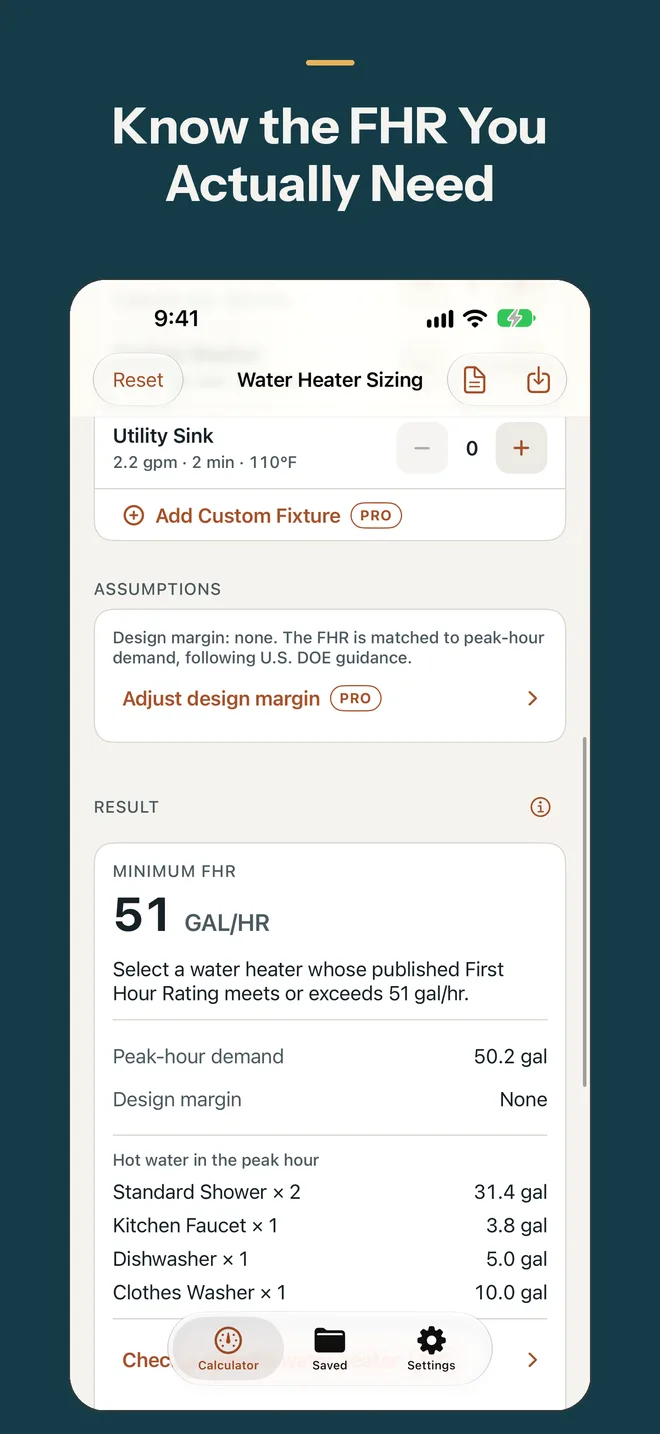
Water Heater Sizing Calculator for iPhone
Take the calculator to the job site
The app runs the same sizing engine as this site, offline. Basic tank and tankless sizing is free. Lifetime Pro, a one-time $4.99 purchase, adds tank vs. tankless comparison, custom fixtures, saved jobs with notes and PDF reports you can send to a customer.