Sizing guide
What size water heater do I need?
For a tank, add up the hot water your single busiest hour uses and choose a model whose First Hour Rating is at least that many gallons. For tankless, add up the hot-water flow of everything that can run at once and choose a unit that delivers that flow at your temperature rise.
Updated
Tank size in gallons and a tankless unit’s advertised maximum GPM are the two numbers people shop by, and neither answers the question on its own. The method below is the one the calculator uses. It takes about five minutes by hand.
Tank water heaters: size by your busiest hour
1. Pick the busiest hour
For most homes it is the morning rush or the evening bath-and-dishes hour. Count every use that happens inside that one hour: each shower, each sink use, a tub fill, a dishwasher or warm wash. Count showers, not people. Two people showering back to back is two showers.
2. Convert each use to hot gallons
A shower at 105°F is a blend of hot and cold, so only part of its water comes from the heater. The hot share is (use temperature − incoming) ÷ (heater − incoming). With 50°F incoming water and a 120°F tank:
| Fixture | Assumption | Hot share | Hot gallons per use |
|---|---|---|---|
| Standard Shower | 2.5 gpm for 8 min at 105°F | 79% | 15.7 |
| Water-Saving Shower | 2.0 gpm for 8 min at 105°F | 79% | 12.6 |
| Bathroom Faucet | 1.5 gpm for 1 min at 105°F | 79% | 1.2 |
| Kitchen Faucet | 2.2 gpm for 2 min at 110°F | 86% | 3.8 |
| Bathtub | 35 gal per use at 104°F | 77% | 27.0 |
| Dishwasher | 5 gal per use, straight from the heater | 100% | 5.0 |
| Clothes Washer | 10 gal per use, straight from the heater | 100% | 10.0 |
| Utility Sink | 2.2 gpm for 2 min at 110°F | 86% | 3.8 |
3. Add them up: that is your peak-hour demand
A family’s weekday morning: three showers, two sink uses, the kitchen tap and a dishwasher load.
Standard Shower 3 × 15.7 gal = 47.1 gal Bathroom Faucet 2 × 1.2 gal = 2.4 gal Kitchen Faucet 1 × 3.8 gal = 3.8 gal Dishwasher 1 × 5.0 gal = 5.0 gal peak-hour demand = 58.3 gal → minimum FHR 59 gal
Open this example in the calculator and change it to match your home.
4. Choose a tank by First Hour Rating
First Hour Rating is the hot water a fully heated tank can deliver in one hour, measured in the federal test (10 CFR 430 Appendix E). It is on the yellow EnergyGuide label and the spec sheet. Choose a model with an FHR at least equal to your peak-hour demand. Ignore tank gallons for this step: a gas tank that reheats fast can outdeliver a larger electric one. 40 vs 50 gallon shows real examples.
FHR is tested with 58°F incoming water. If yours is colder, a tank delivers less than its label says, so leave some margin in cold climates.
Tankless water heaters: size by flow at your rise
1. Find your temperature rise
Rise = outlet temperature − incoming water temperature. Use the coldest month. At 45°F incoming water and a 120°F outlet, the rise is 75°F. How to find your incoming water temperature.
2. Add up what runs at the same time
Only the hot share of each blended fixture passes through the heater. Two showers and the kitchen tap at a 75°F rise need 5.9 gpm through the heater, even though the fixtures themselves flow 7.2 gpm.
3. Convert to heat and input
Heat into the water = 500 × gpm × rise = 221,500 BTU/hr. A 95% condensing gas unit needs about 233,158 BTU/hr of input to deliver it. Open this example.
4. Check the manufacturer’s flow curve at your rise
Advertised maximum GPM is measured at a 67°F rise. At a bigger rise, the unit delivers less. Find your required flow at your rise on the manufacturer’s curve. Converting a rated GPM to your rise explains how.
Why sizing charts disagree
Search for “water heater size for a family of four” and you will find answers from 40 to 75 gallons. The differences come from assumptions that are rarely stated:
- Gallons per shower. AHRI’s sizing worksheet allows 20 gallons of hot water per shower and DOE’s 2001 worksheet 15. Both say they assume no water conservation measures. With today’s 2.5 gpm federal maximum showerhead, an 8-minute shower draws about 15.7 hot gallons at 50°F incoming water; with a 2.0 gpm WaterSense head, 12.6. Hot water per shower.
- Tank gallons vs. FHR. Charts that list tank sizes quietly assume a recovery rate. FHR includes it.
- Climate. Colder incoming water means more hot water per blended use and a bigger rise for tankless.
If you want a shortcut anyway, sizing by household and by bathrooms show worked numbers and the plumbing-code minimums.
Sizing questions
What size water heater do I need for a family of 4?
It depends on how your busiest hour looks, not on headcount. A family of four whose busiest hour includes three showers, two sink uses, the kitchen tap and a dishwasher load needs a First Hour Rating of about 59 gallons with 50°F incoming water. Four showers in the same hour push it higher. The household sizing guide works through 2 to 6 people.
Is it better to oversize a water heater?
A little headroom helps if your busiest hour is hard to predict or your incoming water is very cold, but a tank far larger than your peak wastes energy keeping extra water hot, and an oversized tankless unit costs more and may need a larger gas line or electrical service. DOE's 2001 guidance was to choose a First Hour Rating within about 2 gallons of peak-hour demand.
Does the number of bathrooms decide the size?
Bathrooms are a rough stand-in for how many showers can happen at once. Some plumbing codes set a minimum First Hour Rating by bathrooms and bedrooms, which is worth checking, but your own busiest hour is a better guide to what you actually need.
What temperature should the water heater be set to?
120°F is the common recommendation: the U.S. Consumer Product Safety Commission urges users to lower water heaters to 120°F to reduce scald risk, and DOE says 120°F meets most household needs. A higher setting stores more usable hot water but increases scald risk unless mixing valves are installed.
Sources
- 10 CFR Part 430, Subpart B, Appendix E: Uniform test method for measuring the energy consumption of water heaters, eCFR.
- 10 CFR 430.32: Energy and water conservation standards (showerheads, faucets, dishwashers), eCFR.
- WaterSense labeled showerheads, U.S. EPA.
- Water Heating: Energy-efficient strategies for supplying hot water in the home (DOE/GO-102001-0785, 2001), U.S. Department of Energy.
- Water heater sizing worksheet, AHRI.
- Tap water scalds (Publication 5098), U.S. Consumer Product Safety Commission.
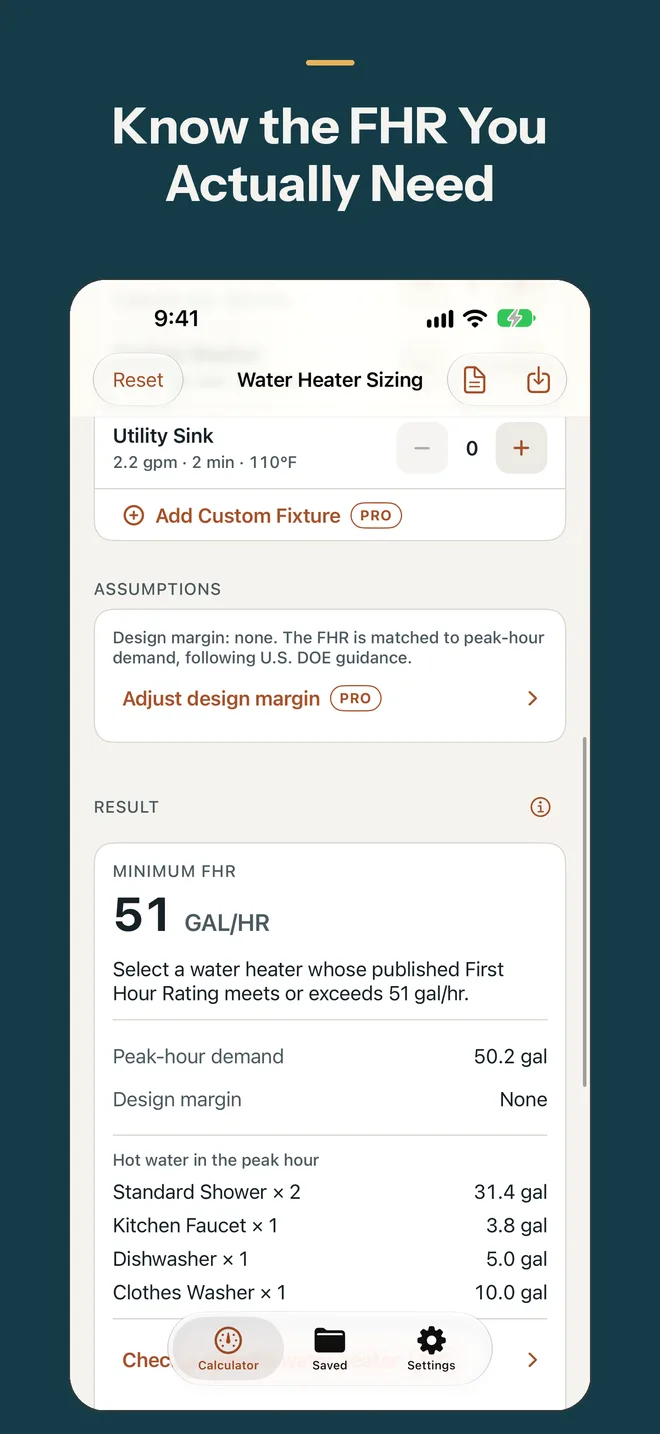
Water Heater Sizing Calculator for iPhone
Take the calculator to the job site
The app runs the same sizing engine as this site, offline. Basic tank and tankless sizing is free. Lifetime Pro, a one-time $4.99 purchase, adds tank vs. tankless comparison, custom fixtures, saved jobs with notes and PDF reports you can send to a customer.