Engine v1 · Fixture library 2026.1
Sizing formulas and methodology
Every formula, default and limit behind the calculators on this site and in the iPhone app, with where each comes from. Where a value is engineering judgement rather than a published figure, it says so.
Updated
The calculators give performance requirements: the First Hour Rating or flow a heater must meet. They do not select equipment, size gas lines, venting or electrical circuits, or check code compliance.
1. Mixed water (hot fraction)
Fixtures deliver water blended to a use temperature. Only part of that flow comes from the heater:
hot fraction = (T_use − T_inlet) ÷ (T_supply − T_inlet)
- T_supply is the tank setpoint or tankless outlet temperature. This is the same energy balance as the F_mix term in ANSI/RESNET/ICC 301.
- Dishwashers and hot-fill clothes washers draw straight from the heater: hot fraction 1.
- A use temperature at or below the incoming temperature is rejected as impossible to blend to.
- A use temperature above the supply temperature is capped at 1 (all hot) with a caution. This is conservative.
2. Tank sizing: First Hour Rating
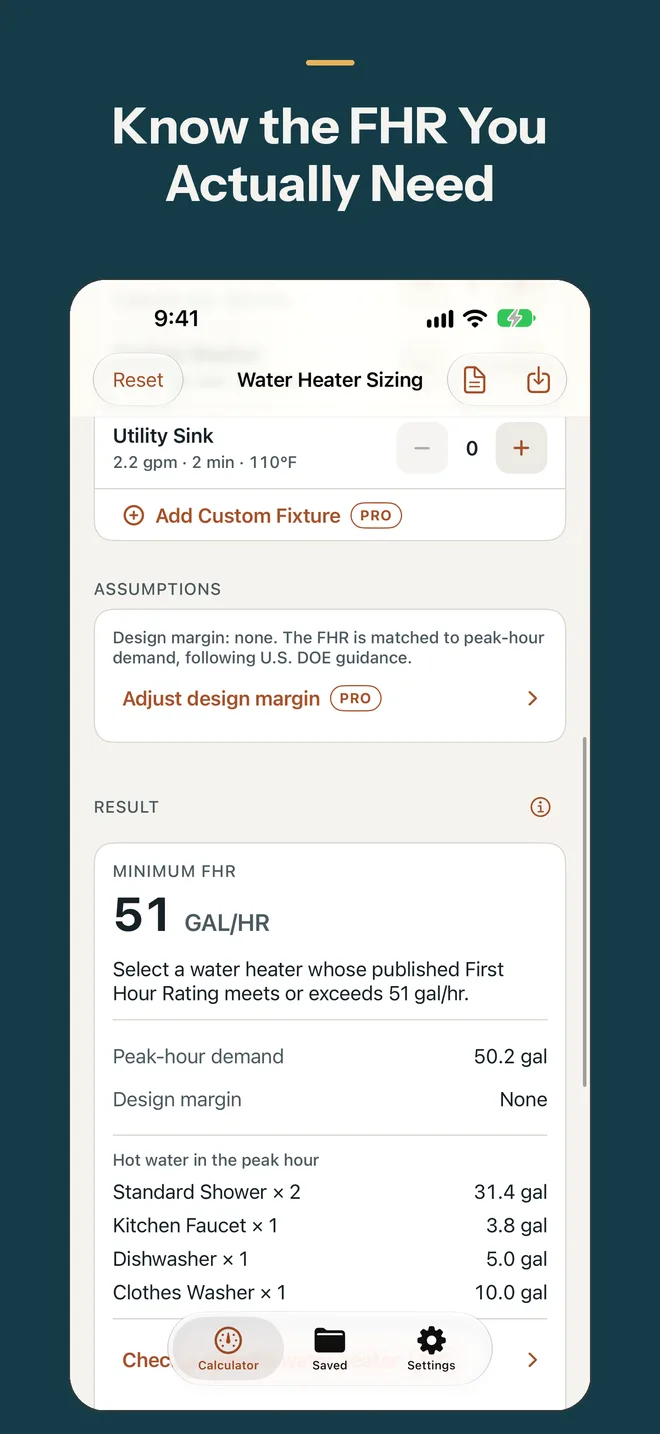
hot water per use = volume per use × hot fraction (volume per use = flow × duration, or a fixed volume) peak-hour demand = Σ uses × hot water per use required FHR = peak-hour demand × (1 + design margin) minimum FHR shown = required FHR rounded up to a whole gallon
- First Hour Rating is defined in 10 CFR 430 Subpart B Appendix E as “an estimate of the maximum volume of ‘hot’ water that a non-flow activated water heater can supply within an hour that begins with the water heater fully heated”. It is tested with 58 ± 2°F supply water and 125 ± 5°F delivery.
- The design margin defaults to 0%. DOE’s 2001 fact sheet advised choosing an FHR “within about 2 gallons” of peak-hour demand, and no authoritative source recommends a fixed percentage. The iPhone app’s Lifetime Pro lets you add one.
- When incoming water is below 58°F, a note says real delivery will be lower than the published FHR. No authoritative correction factor exists, so none is applied.
3. Tankless sizing: flow at a temperature rise
temperature rise = T_outlet − T_inlet required flow = Σ quantity × fixture flow × hot fraction heat load = 500 × required flow × rise BTU/hr into the water required input = heat load ÷ efficiency BTU/hr electric input = required input ÷ 3,412.14 kW
- Hot water only. A tankless unit heats only the hot share of a blended flow. Counting full fixture flow at the full rise overstates the load. The app offers the conservative all-flow basis in Lifetime Pro; the web calculator shows total fixture flow for reference.
- The 500 constant = 8.33 lb/gal × 60 min/hr × 1 BTU/(lb·°F) ≈ 499.8, rounded. Hot water weighs about 8.24 lb/gal, so 500 overstates the load by about 1%, erring toward adequacy.
- Rated rise. Maximum GPM ratings are measured at a nominal 67°F rise (Appendix E). Above 67°F, a note says delivered flow will be lower.
- Residential gas limit. Consumer gas instantaneous water heaters have a nameplate input below 200,000 BTU/hr (10 CFR 430.2). At or above that estimated input, a caution suggests multiple units or commercial equipment.
- Efficiency presets (thermal efficiency, not UEF): gas non-condensing 82% (federal minimum UEF 0.81 for gas instantaneous heaters; a Rheem 199,900 BTU/hr, 5.0 gpm @ 67°F spec back-calculates to about 84%), gas condensing 95% (ENERGY STAR requires UEF ≥ 0.95), electric 99%.
4. Checking a specific heater
- Tank: meets the requirement when published FHR ≥ required FHR. Tank capacity is informational.
- Tankless flow: published at your rise (within 0.5°F): compared directly. Published at a smaller rise: scaled to yours as flow × rated rise ÷ your rise, labelled an estimate. Published at a larger rise: used as-is. The engine never extrapolates upward.
- Tankless input: meets when maximum input ≥ heat load ÷ efficiency. If efficiency isn’t entered, 82% is assumed for gas and 99% for electric.
5. Fixture defaults (library 2026.1)
| Fixture | Flow | Per use | Use temp | Basis |
|---|---|---|---|---|
| Standard Shower | 2.5 gpm | 8 min | 105°F | 2.5 gpm federal maximum (10 CFR 430.32(p)); 8 min ≈ 7.8 min average shower (Water Research Foundation REU 2016); 105°F shower temperature (ANSI/RESNET/ICC 301). |
| Water-Saving Shower | 2.0 gpm | 8 min | 105°F | 2.0 gpm EPA WaterSense showerhead maximum; duration and temperature as Standard Shower. |
| Bathroom Faucet | 1.5 gpm | 1 min | 105°F | 1.5 gpm EPA WaterSense lavatory faucet maximum (federal maximum 2.2 gpm); 1 min per use is an engineering assumption; 105°F handwashing (ASHRAE). |
| Kitchen Faucet | 2.2 gpm | 2 min | 110°F | 2.2 gpm federal maximum (10 CFR 430.32(o)); 2 min per use and 110°F are engineering assumptions. |
| Bathtub | 5.0 gpm | 35 gal | 104°F | 5.0 gpm tub filler (Klein, ACEEE 2019; typical 4–6 gpm); 35 gal fill of a standard tub; 104°F bath temperature (Rheem: 102–106°F). |
| Dishwasher | 1.5 gpm | 5 gal | Hot only | 5.0 gal per cycle federal maximum for standard dishwashers (10 CFR 430.32); 1.5 gpm fill (Rinnai sizing guide); draws directly from the heater. |
| Clothes Washer | 1.5 gpm | 10 gal | Hot only | 10 gal hot water per warm/hot load (ASHRAE: 5–15 gal for efficient washers); 1.5 gpm hot fill (Rinnai; Navien cites 3–5 gpm for some machines). Draws directly from the heater. |
| Utility Sink | 2.2 gpm | 2 min | 110°F | No federal limit for utility faucets; 2.2 gpm assumed (matches lavatory/kitchen maximum). 2 min per use and 110°F are engineering assumptions. |
Cross-check: AHRI’s peak-hour worksheet allows 20 gallons of hot water per shower and DOE’s 2001 worksheet 15; both say they assume no water conservation measures. The flow-based model gives 20 gallons for a 7.7-minute shower from an older 3.3 gpm head and about 15.7 gallons from today’s 2.5 gpm maximum, at 50°F incoming water and a 120°F tank.
6. Validation limits
Out-of-range values are rejected, not clamped, and every problem is reported at once.
| Input | Accepted |
|---|---|
| Incoming water temperature | 32–90°F (default 50°F) |
| Setpoint / outlet temperature | 100–160°F (default 120°F); must exceed incoming |
| Fixture use temperature | 33–160°F; must exceed incoming |
| Flow rate | 0.1–20 gpm |
| Uses per peak hour | 0–99 |
| Fixtures running at once | 0–20 |
| Efficiency | 30–100% |
The default incoming temperature, 50°F, is deliberately on the cold side; users are prompted to enter their own. The default setpoint, 120°F, follows DOE (“A setting of 120°F generally meets most household needs”) and CPSC, which urges users to lower water heaters to 120°F to reduce scald risk.
7. Web-only calculations
- Recovery rate: gallons per hour = input × efficiency × 60 ÷ (500 × rise), using the same constant. See the recovery calculator.
- Electric current: amps = kW × 1,000 ÷ volts, total across all circuits. Not a breaker or wire size.
- Equivalent flow at the 67°F rating rise: required flow × your rise ÷ 67 when your rise is above 67°F, otherwise the required flow. This is the smallest rated flow that passes the model check above.
- Mains water temperature estimates (37 cities): NOAA 1991–2020 normals run through the NREL (Burch & Christensen) correlation as implemented in EnergyPlus: mains = (Tavg + 6) + (0.4 + 0.01 × (Tavg − 44)) × (ΔT ÷ 2) × sin(0.986 × (day − 15 − lag) − 90), lag = 35 − 1.0 × (Tavg − 44). The authors report errors around 4°F and ±5°F variation within a water network. Results and caveats.
8. How the web calculator is kept identical to the app
The web engine is a line-by-line TypeScript port of the app’s Swift engine, performing the same arithmetic in the same order. A test harness runs the app’s real Swift engine and the web engine over the same 427 cases: hand-picked worked examples, boundary values, invalid inputs and seeded random inputs across the full range. Every number must match exactly, and every calculation step, warning and validation message must match character for character.
Where the two differ, it is by design: on the web, the full step-by-step breakdown and the model check are free, and some web-only reference tools exist. The app adds saved jobs, PDF reports, custom fixtures, design margin and a side-by-side tank vs. tankless comparison.
Station data for the city estimates
| City | NOAA station | Annual mean air |
|---|---|---|
| Anchorage, AK | USW00026451 ANCHORAGE INTL AP, AK US | 37.6°F |
| Seattle, WA | USW00024233 SEATTLE TACOMA INTL AP, WA US | 53.7°F |
| Portland, OR | USW00024229 PORTLAND INTL AP, OR US | 55.1°F |
| San Francisco, CA | USW00023234 SAN FRANCISCO INTL AP, CA US | 58.7°F |
| Los Angeles, CA | USW00023174 LOS ANGELES INTL AP, CA US | 63.6°F |
| San Diego, CA | USW00023188 SAN DIEGO LINDBERGH FLD, CA US | 64.7°F |
| Sacramento, CA | USW00023232 SACRAMENTO EXECUTIVE AP, CA US | 61.8°F |
| Phoenix, AZ | USW00023183 PHOENIX SKY HARBOR INTL AP, AZ US | 75.6°F |
| Las Vegas, NV | USW00023169 LAS VEGAS MCCARRAN AP, NV US | 70.1°F |
| Salt Lake City, UT | USW00024127 SALT LAKE CITY INTL AP, UT US | 54.7°F |
| Denver, CO | USW00003017 DENVER INTL AP, CO US | 51.2°F |
| Boise, ID | USW00024131 BOISE AIR TERMINAL, ID US | 53.2°F |
| Albuquerque, NM | USW00023050 ALBUQUERQUE INTL AP, NM US | 57.9°F |
| Dallas-Fort Worth, TX | USW00003927 DALLAS FT WORTH AP, TX US | 66.6°F |
| Houston, TX | USW00012960 HOUSTON INTERCONT AP, TX US | 70.5°F |
| San Antonio, TX | USW00012921 SAN ANTONIO INTL AP, TX US | 69.6°F |
| Oklahoma City, OK | USW00013967 OKLAHOMA CITY WILL ROGERS AP, OK US | 60.1°F |
| Kansas City, MO | USW00003947 KANSAS CITY INTL AP, MO US | 54.7°F |
| Minneapolis, MN | USW00014922 MINNEAPOLIS/ST PAUL AP, MN US | 46.9°F |
| Duluth, MN | USW00014913 DULUTH, MN US | 40.6°F |
| Chicago, IL | USW00094846 CHICAGO OHARE INTL AP, IL US | 51.2°F |
| Detroit, MI | USW00094847 DETROIT METRO AP, MI US | 50.6°F |
| Milwaukee, WI | USW00014839 MILWAUKEE MITCHELL AP, WI US | 49.3°F |
| St. Louis, MO | USW00013994 ST LOUIS LAMBERT INTL AP, MO US | 57.4°F |
| Nashville, TN | USW00013897 NASHVILLE INTL AP, TN US | 60.8°F |
| Atlanta, GA | USW00013874 ATLANTA HARTSFIELD INTL AP, GA US | 63.6°F |
| Miami, FL | USW00012839 MIAMI INTL AP, FL US | 77.4°F |
| Tampa, FL | USW00012842 TAMPA INTL AP, FL US | 74.5°F |
| Charlotte, NC | USW00013881 CHARLOTTE DOUGLAS AP, NC US | 61.4°F |
| Washington, DC | USW00013743 WASHINGTON REAGAN AP, VA US | 59.3°F |
| Philadelphia, PA | USW00013739 PHILADELPHIA INTL AP, PA US | 56.3°F |
| New York, NY | USW00094728 NEW YORK CNTRL PK TWR, NY US | 55.8°F |
| Boston, MA | USW00014739 BOSTON LOGAN INTL AP, MA US | 51.9°F |
| Pittsburgh, PA | USW00094823 PITTSBURGH INTL AP, PA US | 51.8°F |
| Columbus, OH | USW00014821 COLUMBUS PORT COLUMBUS INTL AP, OH US | 53.5°F |
| New Orleans, LA | USW00012916 NEW ORLEANS INTL AP, LA US | 70.5°F |
| Honolulu, HI | USW00022521 HONOLULU INTL AP, HI US | 78.0°F |
Sources
- 10 CFR Part 430, Subpart B, Appendix E: Uniform test method for measuring the energy consumption of water heaters, eCFR.
- 10 CFR 430.2: Definitions (gas and electric instantaneous water heaters), eCFR.
- 10 CFR 430.32: Energy and water conservation standards (showerheads, faucets, dishwashers), eCFR.
- WaterSense labeled showerheads, U.S. EPA.
- Residential water heaters key product criteria, ENERGY STAR.
- Water Heating: Energy-efficient strategies for supplying hot water in the home (DOE/GO-102001-0785, 2001), U.S. Department of Energy.
- Tap water scalds (Publication 5098), U.S. Consumer Product Safety Commission.
- Water heater sizing worksheet, AHRI.
- Burch & Christensen, Towards Development of an Algorithm for Mains Water Temperature (NREL), ENERGY STAR (hosted).
- U.S. Climate Normals, 1991–2020, NOAA National Centers for Environmental Information.
Water Heater Sizing Calculator for iPhone
Take the calculator to the job site
The app runs the same sizing engine as this site, offline. Basic tank and tankless sizing is free. Lifetime Pro, a one-time $4.99 purchase, adds tank vs. tankless comparison, custom fixtures, saved jobs with notes and PDF reports you can send to a customer.