Tankless scenarios
Whole-house tankless sizing: how many showers at once?
A whole-house tankless unit is sized for the busiest moment. Two standard showers need about 3.9 gpm at a 70°F rise; three showers with 40°F winter water need 256,579 BTU/hr of gas input even from a 95% condensing unit, more than one residential unit can supply.
Updated
Flow and heat by scenario and climate
Standard 2.5 gpm showers at 105°F, a 5 gpm tub filler, a 120°F outlet. Each cell is the flow through the heater (only the hot share of blended fixtures) and the heat it must add.
| Running at once | 40°F in (80° rise) | 50°F in (70° rise) | 60°F in (60° rise) | 70°F in (50° rise) |
|---|---|---|---|---|
| 1 shower | 2.0 gpm 81k | 2.0 gpm 69k | 1.9 gpm 56k | 1.8 gpm 44k |
| 1 shower + kitchen tap | 4.0 gpm 158k | 3.9 gpm 135k | 3.7 gpm 111k | 3.5 gpm 88k |
| 2 showers | 4.1 gpm 163k | 3.9 gpm 138k | 3.8 gpm 113k | 3.5 gpm 88k |
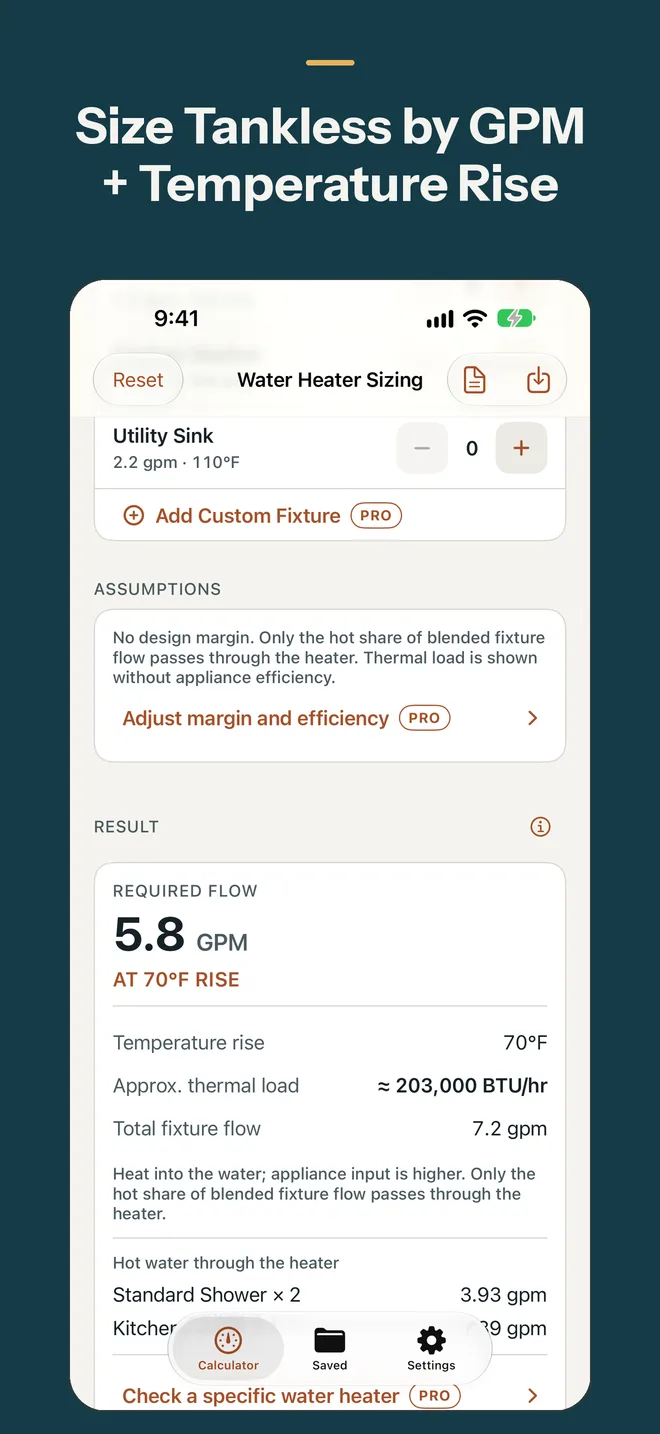
| 2 showers + kitchen tap | 6.0 gpm 240k | 5.8 gpm 203k | 5.6 gpm 168k | 5.3 gpm 132k |
| 3 showers | 6.1 gpm 244k | 5.9 gpm 206k | 5.6 gpm 169k | 5.3 gpm 131k |
| 2 showers + tub fill | 8.1 gpm 323k | 7.8 gpm 273k | 7.4 gpm 222k | 6.9 gpm 173k |
Gas input and electric kW
The appliance must supply more than the heat into the water. Here is the input for each scenario at 50°F and 40°F incoming water:
| Running at once | Gas 82%, 50°F | Gas 95%, 50°F | Gas 95%, 40°F | Electric, 50°F | Electric, 40°F |
|---|---|---|---|---|---|
| 1 shower | 84k | 72k | 86k | 20.4 kW | 24.1 kW |
| 1 shower + kitchen tap | 164k | 142k | 167k | 39.9 kW | 46.8 kW |
| 2 showers | 168k | 145k | 171k | 40.7 kW | 48.1 kW |
| 2 showers + kitchen tap | 248k ⚠ | 214k ⚠ | 252k ⚠ | 60.2 kW | 70.9 kW |
| 3 showers | 252k ⚠ | 217k ⚠ | 257k ⚠ | 61.1 kW | 72.2 kW |
| 2 showers + tub fill | 332k ⚠ | 287k ⚠ | 339k ⚠ | 80.7 kW | 95.5 kW |
⚠ marks gas inputs at or above 200,000 BTU/hr. Residential gas instantaneous water heaters are defined as having a nameplate input below 200,000 BTU/hr (10 CFR 430.2), so one unit can’t cover these peaks.
When one unit isn’t enough
- Two units, either in parallel with a shared manifold or each serving part of the house.
- Lower-flow showerheads. Two 2.0 gpm WaterSense heads at an 80°F rise need 136,842 BTU/hr at 95%, versus 171,053 with 2.5 gpm heads.
- Plan the peak. A tub fill is the largest single demand. If it rarely overlaps with showers, you may not need to size for both.
- A tank instead, where the busiest hour matters more than the busiest minute. Tank vs. tankless sizing compares the two.
Gas line size, venting and electrical service also limit what you can install. A licensed installer checks those against the manufacturer’s instructions and local code.
Whole-house tankless questions
What size tankless water heater do I need for 2 showers?
Two standard 2.5 gpm showers need 3.9 gpm through the heater with 50°F incoming water and a 120°F outlet, and 4.1 gpm with 40°F water. That is about 137,500 and 162,500 BTU/hr of heat into the water.
Can one tankless water heater run a whole house?
Yes, if everything that runs at once fits within its flow at your winter rise. A single residential gas unit tops out just under 200,000 BTU/hr of input. In cold climates, three showers at once can exceed that, which is when two units or a different approach make sense.
How many BTUs for a whole-house tankless water heater?
It depends on flow and rise. Two showers with 40°F water need about 198,171 BTU/hr of input at 82% efficiency. Three showers at the same rise need 256,579 BTU/hr even at 95%.
Sources
Water Heater Sizing Calculator for iPhone
Take the calculator to the job site
The app runs the same sizing engine as this site, offline. Basic tank and tankless sizing is free. Lifetime Pro, a one-time $4.99 purchase, adds tank vs. tankless comparison, custom fixtures, saved jobs with notes and PDF reports you can send to a customer.