Tankless · GPM at your rise
Tankless water heater sizing calculator
A tankless unit has to heat everything that runs at once, at your temperature rise. Enter your water temperatures and fixtures to get the flow in gpm, the heat load in BTU/hr and, if you pick a fuel, the gas input or electric kW.
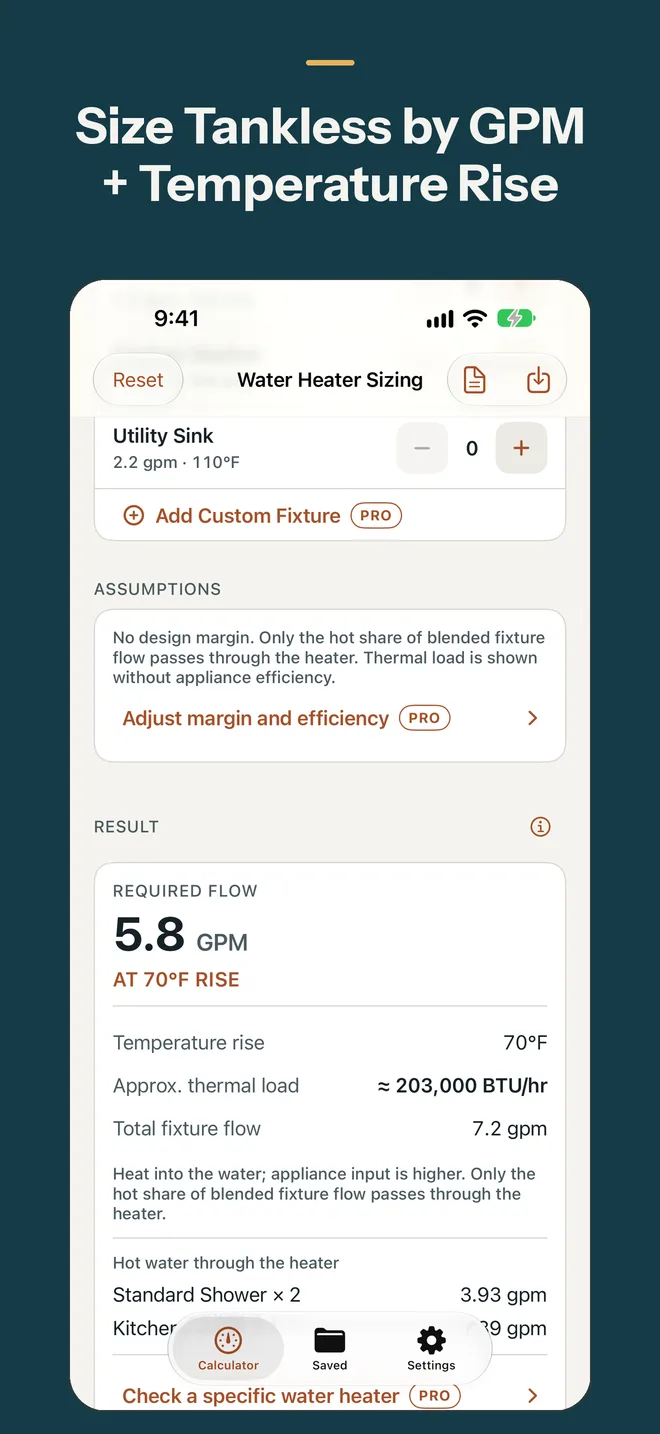
Required flow 5.8 gallons per minute at 70 degree rise
Required flow
5.8gpm
at a 70°F rise
- Heat into the water
- ≈ 203,500 BTU/hr
- Same load at the 67°F rating rise
- ≈ 6.1 gpm
- Total fixture flow (mixed)
- 7.2 gpm
Check 5.8 gpm at a 70°F rise on the manufacturer’s flow curve. Only the hot share of each blended fixture passes through the heater, so this is less than the total fixture flow.
- Standard Shower × 2
- 3.93 gpm
- Kitchen Faucet × 1
- 1.89 gpm
- NoteYour 70°F rise is higher than the 67°F rise used for advertised maximum flow. Check the manufacturer's flow curve at your rise.
Check a specific water heaterFrom its spec sheet
Show the math8 steps
Temperature rise
Outlet − Inlet
120 − 50 equals 70°F
Hot fraction — Standard Shower
(Use temp − Inlet) ÷ (Outlet − Inlet)
(105 − 50) ÷ (120 − 50) equals 0.786
Heater flow — Standard Shower
Quantity × Fixture flow × Hot fraction
2 × 2.5 gpm × 0.786 equals 3.93 gpm
Hot fraction — Kitchen Faucet
(Use temp − Inlet) ÷ (Outlet − Inlet)
(110 − 50) ÷ (120 − 50) equals 0.857
Heater flow — Kitchen Faucet
Quantity × Fixture flow × Hot fraction
1 × 2.2 gpm × 0.857 equals 1.89 gpm
Heater flow
Sum of heater flow
3.93 gpm + 1.89 gpm equals 5.81 gpm
Required flow
Heater flow × (1 + Margin)
5.81 × (1 + 0%) equals 5.81 gpm
Thermal load (heat into water)
500 × Flow × Rise
500 × 5.81 × 70 equals 203,500 BTU/hr
Same formulas, defaults and wording as the iPhone app. Read the methodology and sources.
How tankless sizing works
Tankless capacity is not a single number. A unit’s flow depends on how many degrees it has to heat the water, so a requirement is always stated as flow at a rise.
- Temperature rise = outlet temperature − incoming water temperature. Use winter water; the incoming water guide explains how to measure it.
- Hot fraction for each blended fixture = (use temperature − inlet) ÷ (outlet − inlet). Dishwashers and hot-fill washers draw straight from the heater, so theirs is 1.
- Required flow = the sum of quantity × fixture flow × hot fraction for everything that runs at once.
- Heat into the water = 500 × required flow × rise, in BTU/hr. The 500 comes from 8.33 lb per gallon × 60 minutes.
- Appliance input = heat ÷ efficiency. Electric kW = input BTU/hr ÷ 3,412.14.
Two showers, 50°F in, 120°F out hot fraction = (105 − 50) ÷ (120 − 50) = 0.786 flow = 2 × 2.5 gpm × 0.786 = 3.93 gpm heat = 500 × 3.93 × 70 = 137,500 BTU/hr gas input = 137,500 ÷ 0.82 = 167,683 BTU/hr
Required flow for common combinations
Flow through the heater for standard 2.5 gpm showers and default fixtures with a 120°F outlet. Colder incoming water raises the hot share of every blended fixture, so the same fixtures need more flow and a bigger rise in winter.
| Running at once | 40°F in 80°F rise | 50°F in 70°F rise | 60°F in 60°F rise | 70°F in 50°F rise |
|---|---|---|---|---|
| 1 standard shower | 2.0 gpm 81k BTU/hr | 2.0 gpm 69k BTU/hr | 1.9 gpm 56k BTU/hr | 1.8 gpm 44k BTU/hr |
| 1 standard shower, 1 kitchen faucet | 4.0 gpm 158k BTU/hr | 3.9 gpm 135k BTU/hr | 3.7 gpm 111k BTU/hr | 3.5 gpm 88k BTU/hr |
| 2 standard showers | 4.1 gpm 163k BTU/hr | 3.9 gpm 138k BTU/hr | 3.8 gpm 113k BTU/hr | 3.5 gpm 88k BTU/hr |
| 2 standard showers, 1 kitchen faucet | 6.0 gpm 240k BTU/hr | 5.8 gpm 203k BTU/hr | 5.6 gpm 168k BTU/hr | 5.3 gpm 132k BTU/hr |
| 2 standard showers, 1 bathroom faucet, 1 kitchen faucet | 7.2 gpm 288k BTU/hr | 7.0 gpm 245k BTU/hr | 6.7 gpm 201k BTU/hr | 6.3 gpm 158k BTU/hr |
| 3 standard showers | 6.1 gpm 244k BTU/hr | 5.9 gpm 206k BTU/hr | 5.6 gpm 169k BTU/hr | 5.3 gpm 131k BTU/hr |
| 2 standard showers, 1 bathtub | 8.1 gpm 323k BTU/hr | 7.8 gpm 273k BTU/hr | 7.4 gpm 222k BTU/hr | 6.9 gpm 173k BTU/hr |
Heat load is heat into the water. A gas unit needs more input than this: divide by its efficiency. Tap any row to open it in the calculator.
Check the flow curve, not the headline GPM
The maximum GPM on the box is measured at a 67°F rise: 58°F water in, 125°F out, under the federal test in 10 CFR 430 Appendix E. If your rise is bigger, the unit delivers less. Look up your required flow at your rise on the manufacturer’s performance curve, or use the model check, which scales a rated flow to your rise the same way the app does.
Fixture defaults
These are the defaults behind every result, the same library the iPhone app uses. Showers are the federal maximum flow; your fixtures may use less.
| Fixture | Flow | Use temp | Basis |
|---|---|---|---|
| Standard Shower | 2.5 gpm | 105°F | 2.5 gpm federal maximum (10 CFR 430.32(p)); 8 min ≈ 7.8 min average shower (Water Research Foundation REU 2016); 105°F shower temperature (ANSI/RESNET/ICC 301). |
| Water-Saving Shower | 2.0 gpm | 105°F | 2.0 gpm EPA WaterSense showerhead maximum; duration and temperature as Standard Shower. |
| Bathroom Faucet | 1.5 gpm | 105°F | 1.5 gpm EPA WaterSense lavatory faucet maximum (federal maximum 2.2 gpm); 1 min per use is an engineering assumption; 105°F handwashing (ASHRAE). |
| Kitchen Faucet | 2.2 gpm | 110°F | 2.2 gpm federal maximum (10 CFR 430.32(o)); 2 min per use and 110°F are engineering assumptions. |
| Bathtub | 5.0 gpm | 104°F | 5.0 gpm tub filler (Klein, ACEEE 2019; typical 4–6 gpm); 35 gal fill of a standard tub; 104°F bath temperature (Rheem: 102–106°F). |
| Dishwasher | 1.5 gpm | Hot only | 5.0 gal per cycle federal maximum for standard dishwashers (10 CFR 430.32); 1.5 gpm fill (Rinnai sizing guide); draws directly from the heater. |
| Clothes Washer | 1.5 gpm | Hot only | 10 gal hot water per warm/hot load (ASHRAE: 5–15 gal for efficient washers); 1.5 gpm hot fill (Rinnai; Navien cites 3–5 gpm for some machines). Draws directly from the heater. |
| Utility Sink | 2.2 gpm | 110°F | No federal limit for utility faucets; 2.2 gpm assumed (matches lavatory/kitchen maximum). 2 min per use and 110°F are engineering assumptions. |
Tankless sizing questions
What size tankless water heater do I need?
Add up the hot-water flow of everything that could run at once, at your temperature rise. Two standard 2.5 gpm showers with 50°F incoming water and a 120°F outlet need 3.9 gpm through the heater and about 137,500 BTU/hr of heat into the water. Then find a unit whose flow curve delivers at least that flow at your rise.
How many BTUs does a tankless water heater need?
Heat into the water is 500 × gpm × temperature rise, in BTU/hr. Divide by the unit's efficiency to get gas input. 3.93 gpm at a 70°F rise is 137,500 BTU/hr of heat, which needs about 167,683 BTU/hr of input from an 82% efficient non-condensing unit or 144,737 BTU/hr from a 95% condensing unit.
Why use the hot share of the flow instead of the full fixture flow?
A shower at 105°F is a mix of hot and cold water; only the hot part passes through the heater. With 50°F incoming water and a 120°F outlet, about 79% of a 105°F shower comes from the heater. Manufacturer sizing guides count the same way. Counting full fixture flow as hot is a conservative shortcut that oversizes the unit.
What is the 199,900 BTU/hr limit?
Under U.S. federal definitions (10 CFR 430.2), a residential gas instantaneous water heater has a nameplate input below 200,000 BTU/hr, so most whole-house gas tankless models top out at 199,900 BTU/hr. If your estimated input is above that, you need two units, a different strategy, or commercial equipment.
Can I use this for an electric tankless water heater?
Yes. Choose Electric to see the input in kW. Two showers at a 70°F rise need about 40.7 kW. The electric tankless page converts that to current at 240 volts; breaker and wire sizing is a job for an electrician under the electrical code.
Water Heater Sizing Calculator for iPhone
Size tankless on site, even offline
The app runs the same sizing engine as this site, offline. Basic tank and tankless sizing is free. Lifetime Pro, a one-time $4.99 purchase, adds tank vs. tankless comparison, custom fixtures, saved jobs with notes and PDF reports you can send to a customer.