Comparison
Tank vs tankless sizing: comparing FHR to GPM
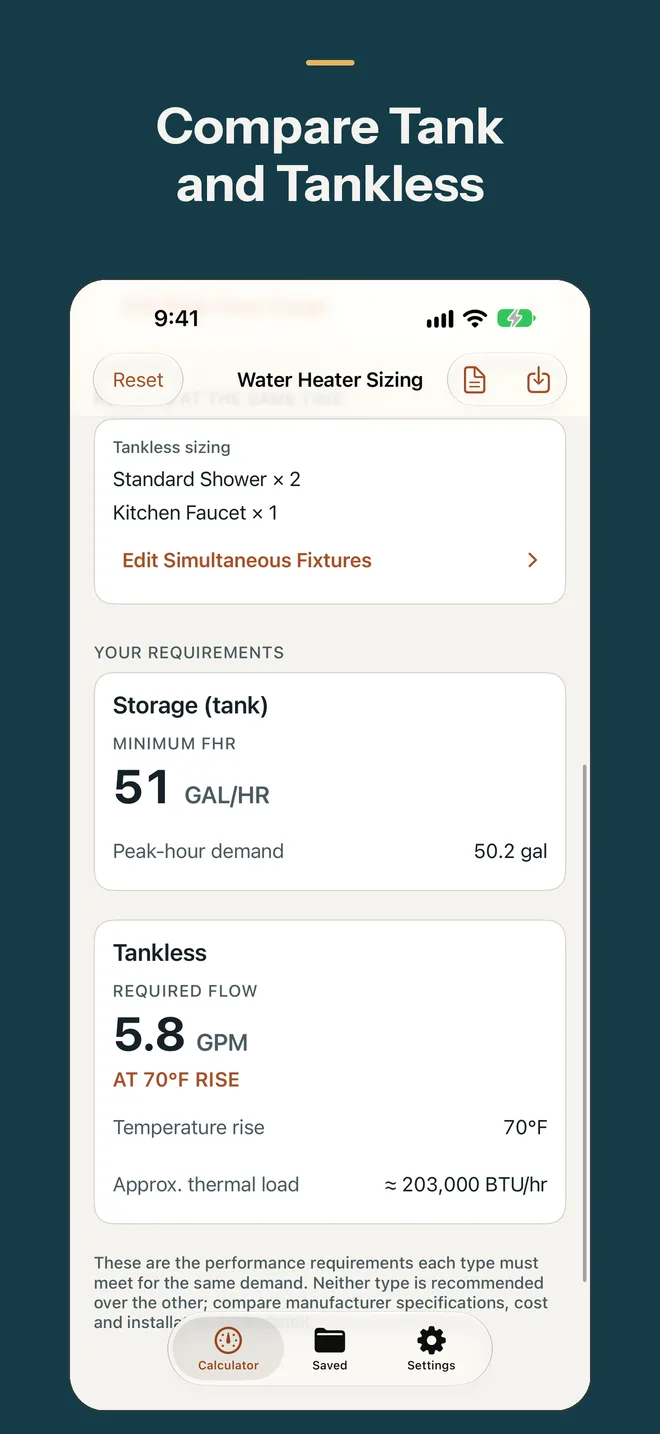
A tank and a tankless unit answer different questions. A tank must cover your busiest hour (First Hour Rating); a tankless unit must cover your busiest moment (flow at your rise). To compare them for the same home, size each one for its own failure mode.
Updated
How each one runs short
| Tank (storage) | Tankless (on demand) | |
|---|---|---|
| Runs short when | A long busy period uses more than it stores and reheats | Too many fixtures open at once for the rise |
| Sized by | First Hour Rating ≥ peak-hour demand | Flow at your rise ≥ simultaneous hot-water flow |
| Rated at | 58°F supply, ~125°F outlet | 67°F rise (58°F in, ~125°F out) |
| Cold climate effect | Delivers less than its FHR | Delivers less flow than its maximum GPM |
| Counts | Every use in the busiest hour | Only what overlaps at the same moment |
The same households, both ways
With 45°F winter water and a 120°F setting, here is what each worked household from our household guide needs:
| Household | Tank: min FHR | Tankless peak | Flow at 75°F rise | Gas input at 95% |
|---|---|---|---|---|
| 2 people | 39 gal | 1 standard shower, 1 kitchen faucet | 3.9 gpm | 154,211 |
| 3 people | 60 gal | 2 standard showers | 4.0 gpm | 157,895 |
| 4 people | 77 gal | 2 standard showers, 1 kitchen faucet | 5.9 gpm | 233,158 |
| 5 people | 104 gal | 2 standard showers, 1 bathroom faucet, 1 kitchen faucet | 7.1 gpm | 280,526 |
| 6 people | 132 gal | 3 standard showers, 1 kitchen faucet | 7.9 gpm | 312,105 |
Notice what drives each column. The tank number grows with every shower in the hour; the tankless number only grows with showers that overlap. A household that staggers showers can be well served by a modest tankless unit and still need a large tank, and the reverse is true for a household where everyone showers at once.
Questions that decide it
- How long is your peak? A long run of back-to-back showers favors tankless; a tank’s FHR is a one-hour budget.
- How much overlaps? Three showers at once in a cold climate can exceed one residential gas tankless unit. See the numbers.
- How cold is your water? Both lose capacity below 58°F; tankless loses it minute by minute. Estimate yours.
- What can the house supply? Tankless gas units need a larger gas line and venting; electric tankless needs a large electrical service. A tank is usually the simpler replacement.
Energy use, cost and space are real parts of the decision too, but they don’t change whether a unit is big enough. Size first, then compare the options that qualify.
Tank vs tankless questions
Is a tankless water heater the same size as a 50 gallon tank?
They can't be compared by gallons. A tank is rated by how much hot water it delivers in the first hour; a tankless unit by how many gallons per minute it can heat at a given rise. The right comparison is whether each covers your household: the tank's First Hour Rating against your busiest hour, and the tankless unit's flow at your rise against what runs at once.
Does tankless ever run out of hot water?
It doesn't run out over time, but it can fall behind at a moment: if more fixtures open than it can heat at your rise, the water cools or the flow drops. A tank can run out over a long busy hour but will supply almost any number of fixtures briefly from storage.
Which is better for a big family?
Both can work if sized correctly. Long overlapping showers favor tankless (no hour limit) as long as the simultaneous flow fits; very high simultaneous flow in cold climates favors a tank or two tankless units. Put both into the calculator and compare.
Sources
Water Heater Sizing Calculator for iPhone
Compare tank and tankless side by side
Lifetime Pro in the iPhone app puts the tank and tankless requirement for the same job on one screen, and saves it with notes or exports it as a PDF report.